Daniel John Thorne
“My work is deeply influenced by Welsh heritage, folklore, and industrial history, drawing on the stories and imagery that have shaped my home. Through my work, I explore bold, graphic storytelling, using contrast and texture to evoke both nostalgia and unease.”
– Daniel John Thorne
Daniel John Thorne (b. 1990) is a contemporary Welsh artist whose work moves beyond romanticised heritage to explore the complex, often-overlooked histories embedded in the Welsh landscape and culture.
Practising professionally since 2025 and based in Bannau Brycheiniog, Thorne is largely self-taught, with an approach informed by his upbringing in South Wales.
Growing up in the South Wales Valleys, Thorne was surrounded by the remnants of the coal and iron industries that once defined the area—abandoned terraces, chapels, and rusted rail bridges standing as monuments to a lost era. These early impressions continue to shape his practice, where history isn’t romanticised but remembered with grit and honesty.
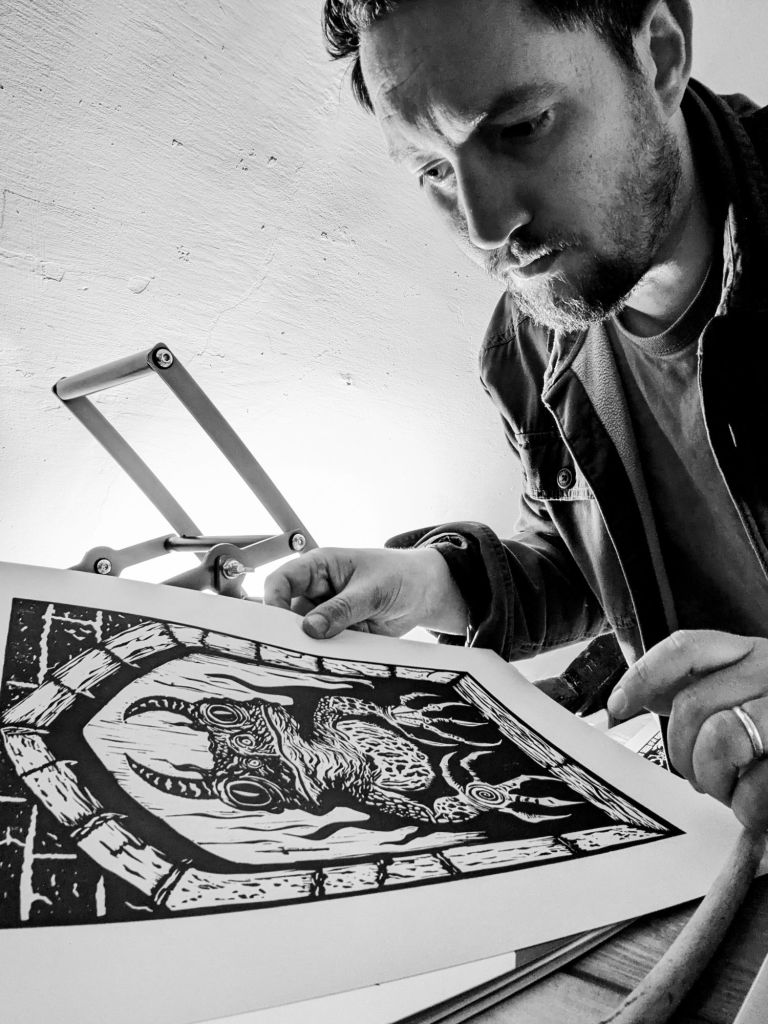
Thorne’s linocut prints are hand-carved and hand-printed using traditional relief printing techniques. Drawn to the raw texture and bold contrast that lino offers, a medium that allows for direct, expressive storytelling without over-refinement. His subjects range from the haggard ironworkers of Merthyr Tydfil to strange folkloric creatures of the coast and mountain, often exploring the tension between myth and memory.
Thorne’s distinctive aesthetic merges expressionistic emotion with narrative clarity, blending elements of German Expressionism, Social Realism, and contemporary folk art to create powerful, human-centred imagery. This is often realised through bold, graphic relief printmaking, where stark black-and-white contrasts create tactile, weathered compositions that feel solid and enduring.
An emerging voice in the Welsh art scene, his work has gained recognition in exhibitions, notably winning Best Print at the2025 Cyfarthfa: Juxtaposed exhibition and being presented to Their Majesties King Charles III and Queen Camilla during their visit to Cyfarthfa Castle.
 Daniel Thorne