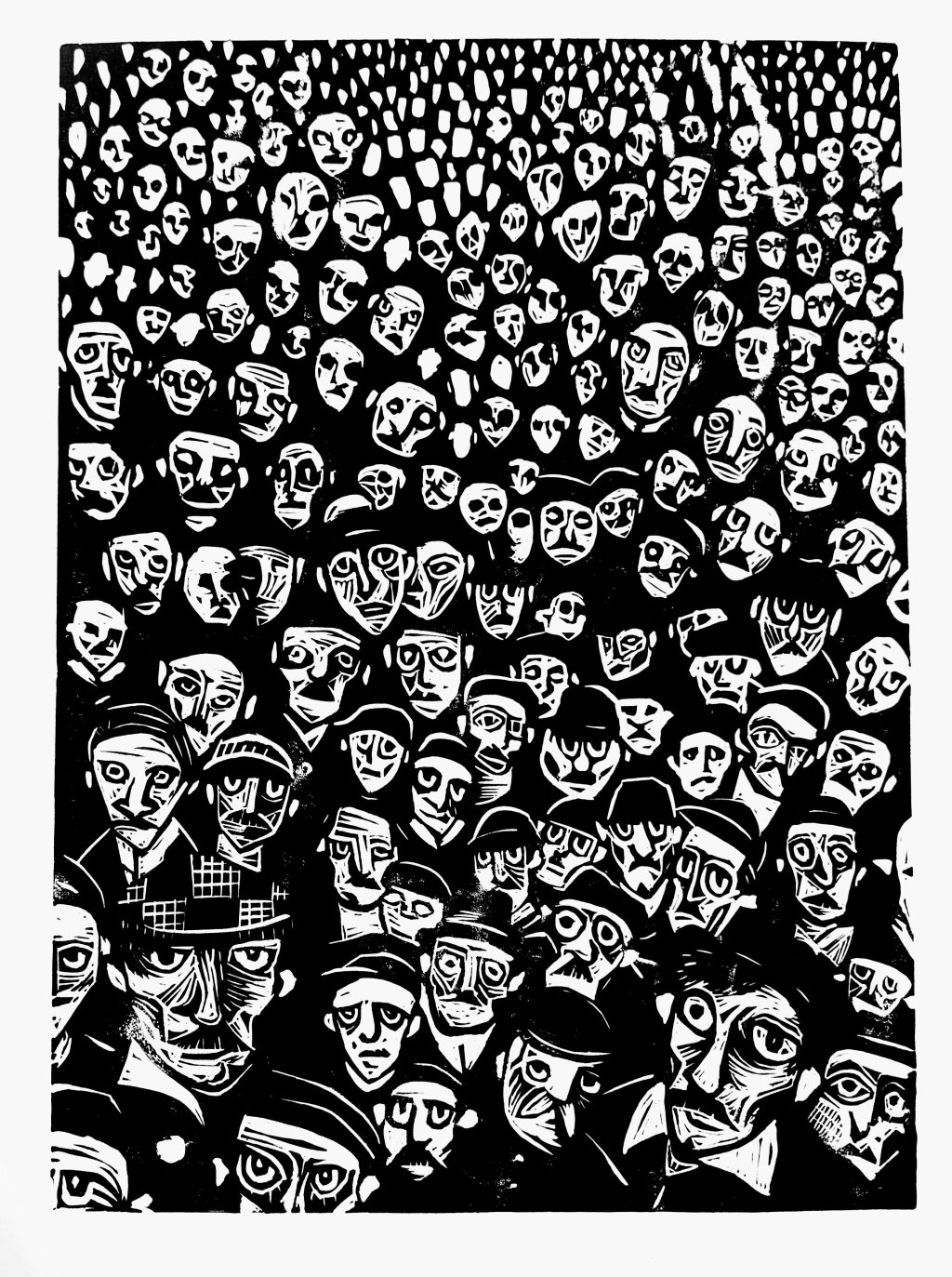
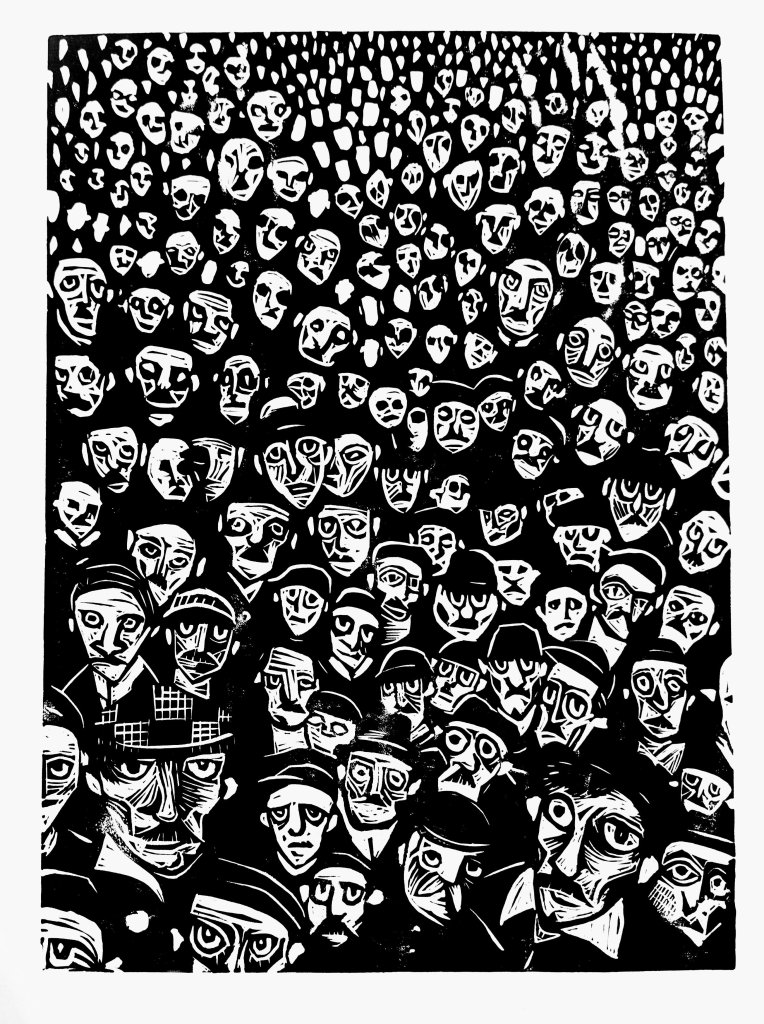
Tonypandy Riots is a piece born from a trip to Swansea’s National Waterfront Museum and research into a significant moments in Welsh industrial history. This one’s taken me a while, as the smaller the faces got, the longer it took to fill the block. There are a lot of them in there, and I’ve lost count of how many. Each one is different.
The print explores the Tonypandy Riots of 1910–1911, when striking miners in the Rhondda clashed with police and, eventually, troops. These short-lived but deeply significant events have left their mark on the memory of the Valleys, wrapped in layers of truth, myth, and politics that I spent months untangling.
The Strike
On 1 November 1910, the South Wales Miners’ Federation (known as “the Fed”) balloted workers. Within days, 12,000 men across the Cambrian pits were on strike.

The trouble started when the Cambrian Collective opened a new seam at their Naval Colliery in Penygraig. They decided to test the rate of production with just 70 miners, then declared the men had worked too slowly. A strange allegation considering miners were paid by tonnage, not hourly rates. They had no reason to work slowly.
The company responded with a lockout, closing the mine not just to the 70 ‘test men’ but to all 950 workers. When strike breakers were brought in from outside the area, serious trouble followed.
The Riots
The riots in Tonypandy were fierce. On the evening of 7 November, striking miners surrounded Llwynypia Colliery, where strike breakers were maintaining the pumps. Stones were thrown, fierce hand-to-hand fighting with police broke out, and after several baton charges, the miners were pushed back into Tonypandy square.
Further rioting occurred on 8 November. Shop windows were smashed, businesses looted by men at the end of their tethers. One miner is said to have died from injuries inflicted by a police baton.
The strike dragged on for months, finally ending in August 1911, with the miners forced to accept just two shillings and three pence per ton of coal extracted. The scars ran deep.
The Print
This print doesn’t try to tell the whole story, just capture a moment. A crowd of tired, angry, defiant faces drawn from historical photographs and my own imagination, a kind of every-crowd, standing for the many who were there.
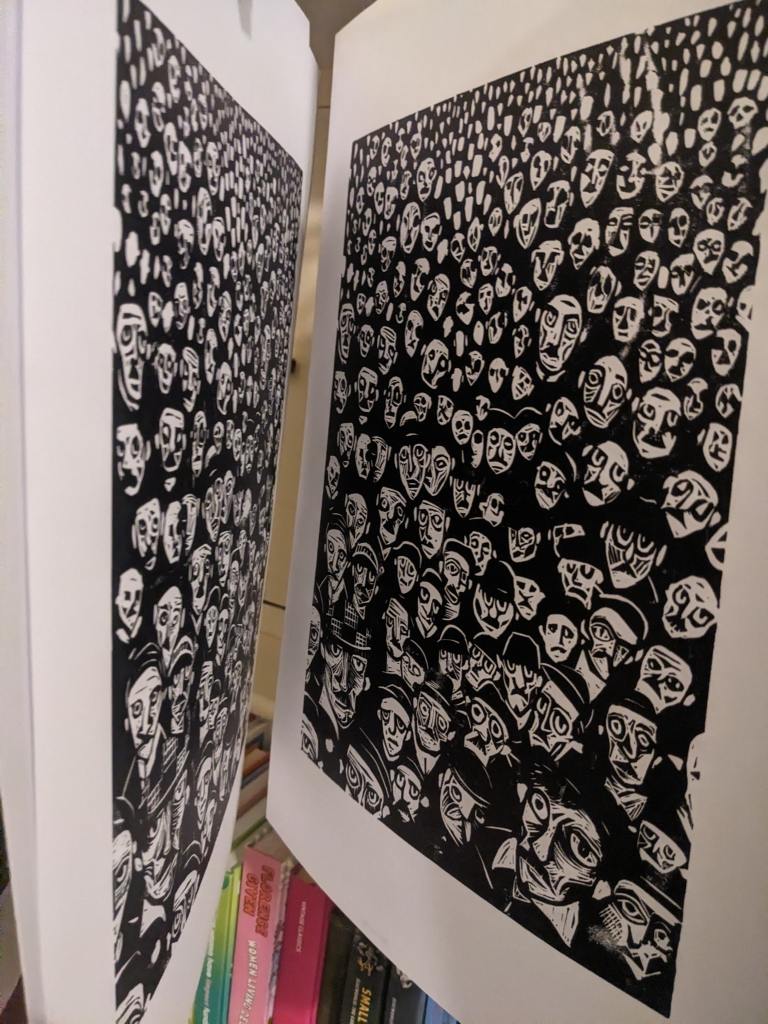
I wanted the print to feel like collective memory made solid, textured, worn, and weathered by time. The strong black-and-white contrast speaks to the stark realities of industrial conflict, while each individual face, carved separately into the lino, represents someone who lived through those events.
The process was painstaking, carving face after face, making sure each one felt individual even in the crowd. That’s the point, though. hey were people with names, families, reasons for standing with their fellow workers despite the consequences.
 Daniel Thorne
Leave a comment